The Disappearing Ink: How America's Media Gatekeepers Bury the Stories That Matter Most
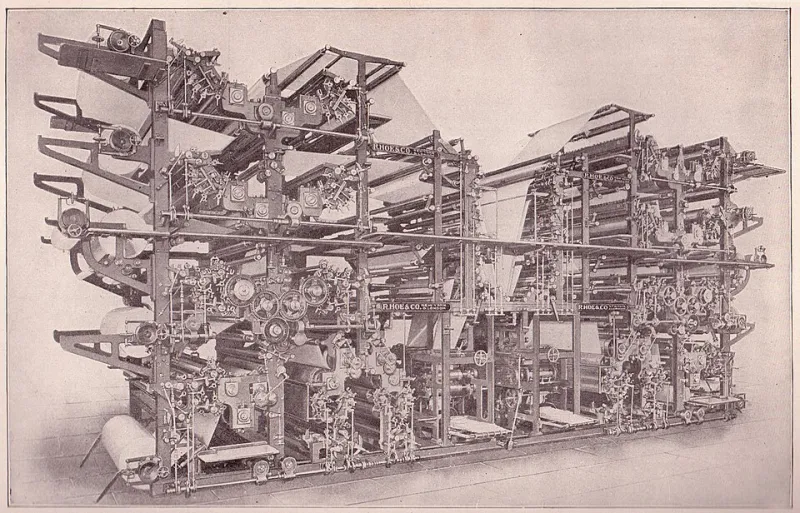
Photo: Sue Clark, Public domain, via Wikimedia Commons
A Nation That Cannot Remember Cannot Govern Itself
There is a particular kind of corruption that does not announce itself with scandal or spectacle. It operates quietly, methodically, through omission rather than commission. It is the corruption of forgetting — the systematic erasure of documented truths from the public consciousness before citizens have sufficient time to demand accountability. In the United States today, this process has been refined to something approaching an art form, and the consequences for self-governance are nothing short of catastrophic.
The American media ecosystem — once imagined as the Fourth Estate, a guardian of democratic accountability — has become, in significant measure, a machinery of selective memory. Stories surface, generate brief controversy, and then dissolve into the churn of the next news cycle, replaced by fresh outrage engineered to consume attention before the previous revelation can calcify into public demand for answers. This is not accident. It is architecture.
The Cycle as Weapon
Consider the documented trajectory of major fiscal accountability stories over the past decade. When the Pentagon failed its sixth consecutive audit in 2023 — unable to account for trillions of dollars in assets — the story received a flicker of coverage before being subsumed by the week's preferred controversy. The Department of Defense has never passed a comprehensive audit. Not once. This is not a minor bookkeeping irregularity; it represents the most colossal failure of financial accountability in the history of the American republic. Yet ask the average citizen today what they know of Pentagon audit failures, and you will be met with a blank expression.
This is the machinery at work. The information cycle is deliberately compressed. By the time a story possesses sufficient documentation to demand legislative response, the editorial gatekeepers have moved the national conversation elsewhere. The story does not die from lack of evidence. It dies from lack of oxygen.
Similar patterns emerged around the Federal Reserve's emergency lending programs during the 2008 financial crisis, where trillions in near-zero-interest loans flowed to institutions whose identities remained obscured for years. When the details finally surfaced through congressional pressure and Freedom of Information litigation, the crisis had long since been reframed as resolved. The window for public reckoning had closed. Those who benefited from that silence remain among the most powerful financial actors in the country.
Who Benefits From Collective Amnesia
The question of motive is not complicated when examined without ideological sentimentality. Institutional memory is dangerous to those whose power depends upon the public's inability to connect cause and effect across time. When citizens cannot trace today's fiscal dysfunction to decisions made five or ten years prior — decisions that were reported briefly and then abandoned — those responsible for those decisions escape consequence.
The beneficiaries of manufactured amnesia are not confined to a single party or ideological faction. The political class, broadly defined, has a shared interest in a citizenry that processes information in fragments rather than patterns. A population that understands the cumulative arc of government spending commitments, unfunded liabilities, and entitlement expansion is a population capable of genuine fury. A population that can only respond to whatever story dominated Tuesday's broadcast is a population that can be managed.
Media consolidation has accelerated this dynamic considerably. As ownership of major news outlets has concentrated into fewer corporate hands — hands with extensive interests in regulatory outcomes, government contracts, and favorable legislative environments — the incentive to sustain stories that challenge institutional power has diminished correspondingly. This is not conspiracy in the theatrical sense. It is simply the predictable behavior of organizations whose financial interests align with the status quo.
The Suppression of Competing Narratives
Beyond the truncation of individual stories, there exists a subtler form of gatekeeping: the preemptive marginalization of entire analytical frameworks. Journalists and commentators who attempt to situate current events within longer historical patterns — who insist on connecting the spending decisions of 2010 to the debt crisis of 2024, or the regulatory failures of one administration to the market distortions inherited by the next — frequently find their work confined to outlets with limited reach, dismissed as ideologically motivated, or simply ignored by the amplification networks that determine what millions of Americans encounter.
The effect is a citizenry that experiences national life as a series of disconnected emergencies rather than the cumulative consequence of sustained institutional choices. Each crisis appears to arrive without precedent. Each failure seems unprecedented. Each call for accountability is met with the implicit question: accountability for what, exactly? The dots have been carefully separated so that no one may connect them.
This is particularly acute in matters of fiscal policy, where the relationship between past decisions and present consequences is most legible — and most damning. The national debt does not materialize spontaneously. Unfunded liabilities do not appear without legislative authors. The inflation that diminishes the savings of working Americans is traceable to specific monetary and spending decisions made by identifiable actors over identifiable time periods. But that traceable arc requires institutional memory to perceive, and institutional memory is precisely what the current media architecture is designed to prevent.
The Reckoning That Memory Demands
There is a theological principle embedded in the very name of this publication, and it applies with uncomfortable precision to the subject at hand: judgment requires witness. A civilization that cannot bear witness to its own choices — that permits those choices to be systematically obscured before their consequences can be understood — is a civilization that has surrendered its capacity for self-correction.
The Founders understood that a free press was indispensable not merely because it reported events, but because it sustained the continuity of public knowledge across time. Without that continuity, citizens cannot hold power accountable, cannot evaluate whether promises have been kept, cannot distinguish competence from catastrophe. The press was to be the nation's memory. What happens when the memory becomes selective? When it serves the interests of those it was designed to scrutinize?
What happens is precisely what we observe today: a political class that operates with increasing impunity, confident that no single revelation will survive long enough to generate sustained consequence. What happens is a fiscal trajectory that accelerates toward crisis while the mechanisms that might arrest it are rendered inoperable by a public that cannot perceive the pattern.
The judgment that is coming for America will not arrive because citizens were insufficiently warned. It will arrive, in part, because the warnings were issued, documented, published — and then buried beneath the next day's distraction before they could take root. That burial is not innocent. It is not inevitable. It is a choice, made by identifiable institutions serving identifiable interests.
And choices, as history has always insisted, carry consequences that no news cycle is long enough to erase.